
Scientists have found many things
buried and preserved in ice. Some of these things are stranger than
others. And some of them are so bizarre, they truly baffle the mind.
While many of these findings are typically woolly creatures, primed and
ready for the arctic environment, others are inexplicably weird. Here
are a few of the more choice, mysterious, and enthralling findings
scientists discovered in the icy worlds of the deep north and south.
Prepare yourself.
1. Frozen lighthouse
Sometimes the cold gets so bad as to freeze the surrounding architecture. This is actually a common occurrence in Michigan, surprisingly enough. This particular lighthouse is one such entity to succumb to the cold, and oh man did it succumb. Its spiral staircase is clearly frozen, and presumably unmanned.

2. Mammoth brains
One of the weirder things these scientists have found in ice is the brains of a woolly mammoth. Now, these weren’t brains you’d want to eat (I know what you were thinking). This mammoth, however, was not found in an ice patch but instead some derelict permafrost of the Laptev Sea coast.
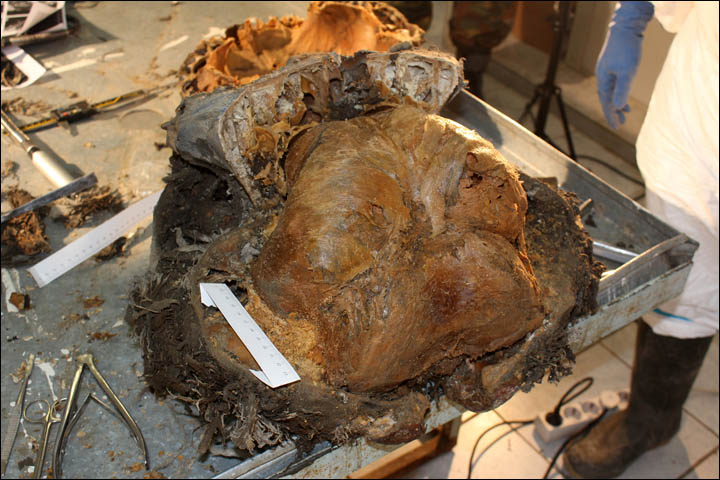
This is one of the only preserved species of mammoth found with an intact brain to-date. The specimen is around 39,000 years old, which makes the finding even more spectacular. Sadly, the little mammoth was but a child—somewhere around six to nine years old. This sadly short lifestyle is likely the reason scientists found it in the first place. It likely fell to its death immediately.
3. The frozen fox
Sometimes the animals scientists find in ice are more contemporary. And this makes sense—modern animals can freeze in ice just like those that existed back in the day. And this is the case with certain foxes. Their cuteness, in other words, was not enough to prevent them from getting frozen solid in the ice cold waters of the Arctic conditions in which they were found.

4. Alive in ice?
Sometimes the things scientists find in ice aren’t even dead. Sometimes these unholy findings aren’t the result of frozen mishaps, but instead normal changes to the environment. Certain alligators, for instance, can survive in ice for the duration of an entirely frigid and perilous winter.

5. Planes on ice
Of the other odd things scientists have found in ice is crashed technology. While not ancient, this tech is definitely a surprise. Long presumed lost, sometimes these things have a way of being found again. In 1952, for instance, a military plane bound for Anchorage, Alaska came up a little bit short, crashing into a nearby glacier.

6. A fish-eat-fish world
Here, we have an interesting finding: a fish frozen in the process of eating another fish. It’s amazing to consider that the water had gotten so cold so quickly that the animals within the water had frozen almost immediately. And what’s even more amazing is that an ice fisherman was able to retrieve the specimen.

7. A dinosaur mummy
Some of the things we find in ice really a lot more than just the familiar woolly mammoth or tiger. Instead, these other findings show things that reveal another realm of biology. In this case, we have a finding that revealed another way in which ancient ice-age animals would defend themselves.

8. A dive to remember
These birds were just trying to find themselves some food. Unfortunately, after a sharp dive beneath the surface of the water, the animals had suffered a deep freeze from which they would never recover. The water, in other words, was so cold that after a few seconds beneath the surface they had become entirely frozen.

9. Frozen ice-age puppies
Sometimes scientists find something a little more close to home. In this case, they had located an ice age puppy in the ice. While the thing wasn’t as well-preserved as other ice age specimens, it was surprisingly well preserved. Scientists dated this puppy to be something around 12,460 years old.

10. Copper arrowhead
Other weapons, you ask? Why yes, there’s more. This copper arrowhead, for instance, was found within one of these ice patches. And what’s astounding about a copper arrowhead? It suggests that the ancient culture in question understood metallurgy. This suggests loads about the modernity of the society that made it.

11. Vikings
Another of the more interesting things that scientists have found is the trace of Vikings. In Juvfonna, Norway, for instance, scientists have found Viking gear within several glaciers. Among the mostly reindeer-manufactured gear, they also found sticks, bows and arrows, and the leather parts of shoes.

12. ‘Bloody’ ice
Mysterious things happen in Antarctica. One of the weirder of these is this blood-red stream that flows from the appropriately named Blood Falls glacier. This spooky flow looks like blood but, in reality, it’s just a bunch of iron-rich water. It’s the same element, in other words, that keeps Mars its characteristic red.

13. Old forests
As glaciers advance, they essentially crush everything in their way. But, also, as they move they pick up rocks and debris. Scientists call this sediment moraine. This moraine can act as a cushion for some of the stuff that the glacier would otherwise crush. And this is the case for certain old forests.

14. Human sacrifice
In Chile, some things were found in the ice that were a little more disconcerting than most. These things were Inca sacrifices. It was ritual, for instance, for the Inca to sacrifice children and other unfortunate souls to the highest peaks of the Andes Mountains. Such traditions aren’t uncommon to the societies of our past.

15. Human sacrifice: part II
Like other societies of the time, the Inca were fond of human sacrifice. During rituals that paid homage to the Sun God Inti, they thought they had to go to extremes—in this case extreme heights and cold—to appease. They didn’t test their hypotheses by not sacrificing the children to see what happens.

16. How ice preserves
How can ice preserve all of these materials so well, you ask? Because the frigid cold prevents bacteria and other decomposers from working their magic. In environments like the Arctic, for instance, it is so cold and deprived of oxygen that bacterial decomposers can’t function. Or if they do function, they don’t at the same rate as if there were in a warmer climate.

17. The White War
Among the more strange things we’ve found in the ice is the remnants of wars’ past. During WWI, for instance, certain battles were fought high up in the Alps. This icy trench warfare was essentially the worst way in which to fight a war. Frigid temperatures left many soldiers frostbitten and many others even worse.

18. Other people found in ice
While disconcerting, Otzi man and the Inca sacrifices were not the only people found in ice. In fact, there have been many, many people who have suffered similar fates. Recently, for instance, scientists found a body about 300 years old. What’s amazing about this body is that he was an ancestor to the nearby First Nations people.

19. Woolly mammoth
Among the more normal things scientists have found in ice is the woolly mammoth. This prehistoric woolly beast roamed the lands of the Arctic in places like Alaska and Siberia. One particular mammoth specimen was recently resurrected from an ice tomb in Siberia. It was dated at around 39,000 years old.

20. Spears
Other human implements have been found in the wake of these wasting ice patches. In Yellowstone, for instance, an area where scientists previously found no sign of humans, scientists found a 10,300-year-old spear. That’s very old, in case you didn’t know, for human standards.

21. Otzi Man
Otzi Man is one of the more famous humans to have been found in the snow. About 5,300 years old, this well-preserved body was found in the Alps between Austria and Italy. One of the more amazing details about the Otzi man is that he’s a genetic ancestor to many people in the nearby Austria area.

22. Woolly rhino
Animals with abundant fur are common to areas of extreme cold. And that’s why we used to have the woolly rhino. One recent specimen was found so well-preserved that it came fur covering all parts of its body that weren’t gnawed on by predators. This particular rhino was thought to be around 18-months-old.

23. Sabretooth tigers
Also called cave lions, these tigers roamed much of the arctic circle. Some Russian scientists recently found some unique specimens in Yakutia, Siberia. Like the woolly rhino, these specimens were cubs. And, also like the woolly rhino, these were so well-preserved that they still had fur.

24. Atlatl darts
Among other fascinating items that scientists have been finding is the ancient weaponry of humans. One of these weapons is the atlatl (pronounced at-latel). The atlatl was one of the first forms of weaponry made by anatomically modern humans. It preceded, for instance, the bow and arrow.

25. Dart shaft
In one instance, for example, scientists found a dart shaft in the poop of one of these caribou. While it may sound gross, it’s also deeply informative. What does it reveal? Well, for one, it says that there were hunters in the area. Secondly, it implies that these hunters were some level of craftsmen.

26. Ancient bacteria
Of the weirder findings scientists have found in ice has been old bacteria. Some recent specimens, for instance, have been dated back to around a quarter million years old. A different little chunk of bacteria-riddled ice was dated at around 8 million-years-old. That’s pretty old.

27. More ancient bacteria
There are other types of bacteria, however, latent in the ice that are far more dangerous. Sometimes they’re carried in the bodies of dead animals, but sometimes they exist all on their own. Is there anything favorable about these ancient forms of bacteria? The answer is no—they’re bad news. Whereas with modern bacteria we’ve developed immunity, these old ones we’ve had no exposure to.

28. Global warming
A lot of these finds are made possible by the relentlessly shifting climate. As the atmosphere warms, for instance, the rate at which snow melts and permafrost fade accelerates to a point at which more is lost than gained. This means that bodies and other elements previously buried will be unearthed (un-iced?) and left to wear in the elements.

29. Caribou droppings!
One of the more consistent findings in these ice patches is animal excrement. While that may not sound too exciting, animal waste reveals all sorts of things about the animal and its habits. And this, in turn, tells us about how the animal lived all those years ago. You can learn whether the animal was herbivorous or carnivorous, for instance.

30. Problems with warming
While the accelerated melting due to warming is fostering a greater yield for glacial archeologists and the like, it’s also yielding a greater rate of decomposition for the same artifacts. Why is this? Because, as the ice and permafrost melt, they enable the exposed artifacts to undergo the weathering processes they were previously shielded from.

31. Ice patches
Some of the places that are experiencing a particularly accelerated rate of deterioration are the arctic ice patches. These form when snow aggregates and doesn’t melt from the year prior. As these preserved layers build, you get an ice patch. Essentially, you develop a layer of ice that is normally covered in snow and it doesn’t get the chance to melt.

32. Building shelter
Another thing these scientists found in the ice patches was some rare wood. It was nowhere to be found, in other words, around the site where it was located. What this means is that the nearest tree from which the wood could’ve come was several miles away—i.e., it was stripped, carved, and carried all the way to the site of the ice patch.

33. Birch basket
Scientists also found a well-preserved birch basket in one of these patches. While not mysterious per se, such a finding does reveal some about the people who made the basket and what they used it for. Discovered in 2003, this basket was found to be 650 years-old.

34. Glacial and ice patch archeology
In response to the effects of global warming, emerging fields of science have been flourishing. Of these few disciplines are glacial and ice patch archaeology. Both of these fields are oriented toward studying the remnants found in receding glaciers, permafrost, and ice patches.

35. Gopher stick
Now, this isn’t what it sounds like. It wasn’t, in other words, a stick made of gophers. Wouldn’t that be fun? Instead, it was a stick—a contraption, rather—used to capture gophers. This complex trap worked by looping a snare around a durable carved stick. This stick would then be connected to a strong sting.

36. What we find where
Another interesting find with these ever-receding glaciers and ice patches is a different pattern of activity. At certain mountain ranges, for instance, we find certain objects unique to that region. This enables us to understand what different people were doing when they were in each of these mountain ranges.

37. Willow bow
Another weapon scientists have found in these receding ice patches is the willow bow. Carved from the willow tree, this bow was used to kill and hunt elk and reindeer. One particular bow was found to be 340 years old. This bow specifically was actually one of the first artifacts found by ice patch archeologist Tom Andrews.

38. Weird things in ice
As the ice patches in the world continue to melt back and the glaciers recede, we will inevitably find weirder and weirder things in the ice. So far, however, we know these things to range from dead people to long-extinct animals to archeologically significant objects like baskets and bows.

Comments
Post a Comment